
What is denied in nature returns as violence in culture.
— Susan Griffin, Woman and Nature
We modern people speak of progress with the confidence earlier ages spoke of God. We assume that history moves forward, that the future will improve upon the past, that novelty is advancement, and that humanity is going… somewhere. Even those who distrust politics or religion often retain this deep faith: that time itself is on our side.
For a long while now, I’ve rejected the idea of progress. I believe it is another human story—a fiction we tell ourselves to lend meaning to our lives and, often unconsciously, to rationalize the insane decisions of the modern world.
The progress story did not arise from nowhere. In the West, it emerged from older Christian ideas: that history has direction, that time moves from fall to redemption, that suffering can be justified by a better future, that there is an end toward which the world is moving. As religious belief weakened, the structure remained. Providence became economics, salvation became technology, and heaven became an always-tomorrow.
We flatter ourselves that we have replaced myth with reason, but all we’ve done is replace old myths with new ones that do not admit they are myths.
The philosopher John Gray has argued that people in modern secular societies still think in Christian shapes. We imagine both history and civilization as having direction, and humanity as improvable. But evolution has neither direction nor moral arc. Natural selection does not move toward justice, wisdom, enlightenment, or the perfect form. It produces adaptation, diversification, and extinction. Nor does history reveal any clear forward path. Civilizations rise, decay, conquer, fragment, forget, collapse and begin again. Human beings gain powers they cannot wisely use, then mistake power for maturity.
Change is real. Progress is interpretation.
This distinction matters because many of the achievements modern people cite as proof of progress are real only in a partial sense. Yes, there have been extraordinary inventions: anesthesia, sanitation, emergency medicine; the ability to repair broken bones, preserve food, communicate across distance, and relieve certain forms of suffering that earlier people had to endure helplessly. These are not illusions.
But neither are they the whole picture.
The story of progress usually begins too late. It compares the industrial present with the brutalities of premodern states, crowded cities, endemic disease, and feudal hierarchies; then declares victory. This story forgets that many of those conditions were themselves products of earlier “advances”: the agricultural revolution, urban concentration, empire, domestication, class society, organized and industrial warfare, and the accumulation of surplus under coercive rule.
When human beings shifted from hunting and gathering to settled agriculture, we became able to store grain, grow our population, build monumental architecture, create written records so we could pass on knowledge, and with increased population, we could specialize our work.
Usually ignored is what we lost in the process. Archaeological evidence suggests that many early agricultural populations suffered worse nutrition, shorter stature, smaller brains, more dental decay, more infectious disease, and harder repetitive labor than some foraging peoples. Hierarchies hardened, slavery emerged at scale, women lost status, and land became property. Kings appeared and with them taxation and armies.
We lost the natural world too; no longer our home and the foundation of our culture and our myths, we replaced nature with gods in human form, and built great monuments to the other world. The raven, the coyote, the bulls, and the bears became simply animals again.
Civilization created new problems, then celebrated itself for managing them.
This pattern continues. Industrial society cures diseases linked to urban crowding while generating chronic illnesses of sedentary life, pollution, stress, loneliness, and ultra-processed diets. It offers labor-saving devices while trapping millions in forms of work experienced as meaningless. It connects continents while dissolving local belonging. It extends lifespan while filling those years with anxiety, distraction, ill-health, and ecological ruin. It gives abundance to some through systems that impoverish others and consume the living world.
None of this means we should romanticize the ancient world, as if ancestral life were a pastoral idyll. Prehistoric life contained danger, grief, hunger, injury, and uncertainty. Children died. Teeth and legs broke. Winters were harsh. There were surely cruelties then as now. Human beings have never lived easy in paradise.
Neither should we romanticize modernity simply because it is ours and filled with technology our distant ancestors would perceive as magic.
~~~
Paul Kingsnorth uses the term “the Machine” for the system that turns all things into means for something else. Forest becomes timber. Rivers become resources. Human attention becomes monetizable data. Time becomes productivity. Place becomes real estate. Tradition becomes content or virtue signaling. In such a world, movement is confused with purpose. If something is changing quickly, we assume it is advancing. If it is old, rooted, and slow, we assume it is obsolete.
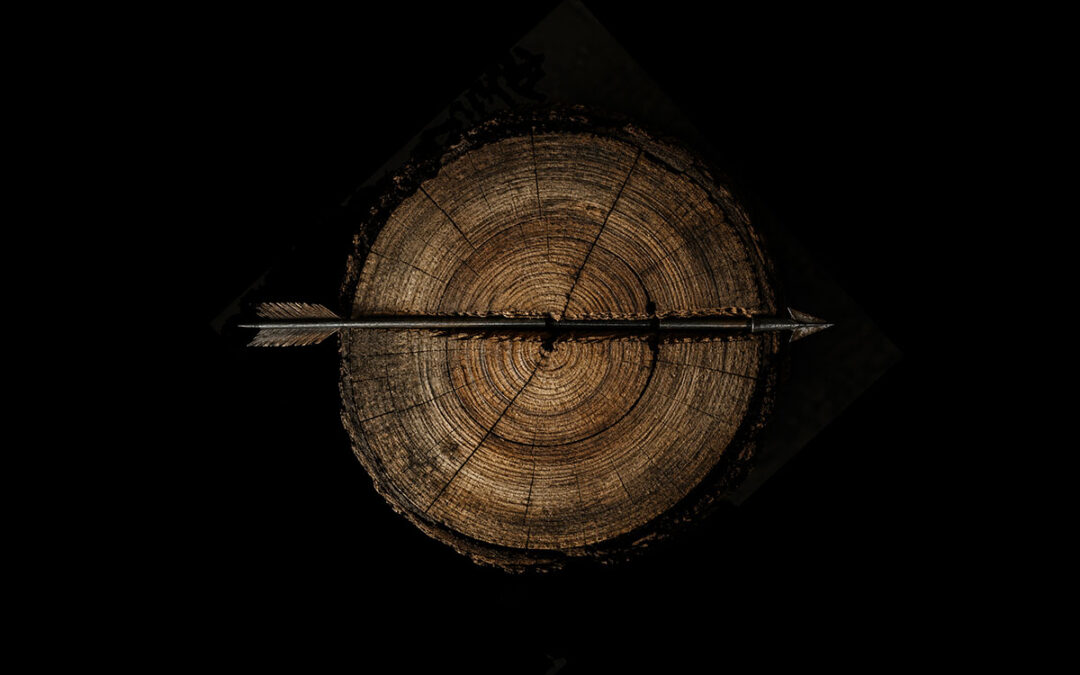
The Machine depends on arrow-time: the sense that life is heading somewhere better and that to resist acceleration is to resist reality itself.
I’ve read that older societies imagined time not as an arrow, but as a circle. People lived and breathed a world in which seasons returned and with them the animals and plants we built our myths around. And so, our rituals repeated. Our ancestors remained present in stories, with birth and death woven into recurring patterns. This circular imagination had limits and blind spots, but it granted something modern people lack: permission to inhabit the present.
If life is a circle, we need not constantly justify ourselves through future achievement. If life is an arrow, the present is always inadequate.
This may explain much of our restlessness. We are uncomfortable doing nothing because idleness feels like falling behind and busyness feels like being important. Deprived of belonging, we pursue identity. We are uncomfortable without progress because identity depends on motion. Deprived of reverence, we seek spectacle. We are uncomfortable without meaning because we have detached meaning from simply being alive and relocated it into projects, metrics, and destinations.
We don’t ask how to live well here and now; we ask what comes next.
~~~
It is no measure of health to be well-adjusted to a profoundly sick society.
— Mark Vonnegut
The myth of progress begins in separation. As Susan Griffin wrote, “We know ourselves now as separate from everything.” Once severed from soil, season, creature, ancestor, and place, we become available to the Machine. We can no longer live in the present because the present has been demoted to a corridor between upgrades on the path of progress.
The myth of progress survives by measuring only what it knows how to count: production, speed, life expectancy, output, convenience, data. Griffin’s poem Quantity describes how what can be measured is what is made manifest. Everything that cannot be quantified—attention, belonging, relationship, silence, reverence, presence—fades from view, not because it has ceased to exist, but because it has been rendered illegible.
A society can grow richer—as measured by bits of green paper and numbers in a computer—while becoming more deranged. The true wealth of the world, the world we used to inhabit for free, is being destroyed at an accelerating pace by the physical manifestation of this story we call “progress.”
The real alternative to the myth of progress is not despair, nostalgia, or reaction; it is humility. It is to recognize that gains are reversible, losses are ignored, and no civilization escapes tragedy by calling itself advanced. It is to see that history has no guaranteed destination, and therefore responsibility lies with us in the here-and-now rather than with some promised future.
The myth of progress will collapse soon as the reality of the destruction it has manifested becomes more clear to those still caught in its fantasy. The world we’ve wrought in the name of progress is already collapsing as it erodes and fragments the web of life it depends on.
In the face of this collapse, how do we live? Perhaps we can recover forms of meaning that don’t depend on grand narratives of always moving forward. We can develop loyalty to place and to the natural world; care for kin; build friendship, skills, and attention; cultivate reverence for the more-than-human world; accept our limits; and have gratitude for ordinary days.
The world turns in cycles whether we acknowledge it or not. Seasons still return. Our bodies age. Empires fall. Forests grow slowly. Children are born and death awaits us all. The arrow of progress has never abolished the circle of life; we’ve only been distracted from its rhythm by the shiny, shiny objects that progress story promised us.
We imagined we had outgrown myth. Instead, we chose one perfectly suited to the Machine.
The task now is not to move faster and feed the Machine. It is to remember the shape of things and, as Lynn Unger wrote in her poem, The Last Good Days:
The answers
are immediate and small.
Wake up. Give thanks. Sing.
Recent Comments